

Next stop Syria: The Russian Navy's aircraft carrier, the Admiral Kuznetsov, is preparing to steam from the Arctic to Tartus, Syria, where Moscow has maintained a naval base on the Mediterranean for 40 years. Photo: AP
As Russia’s lone aircraft carrier prepares to steam from the Arctic to a Russian-operated naval base in Syria, Sergei Lavrov, Russia’s Foreign Minister, is on the attack, warning against outside military intervention in Syria’s slow motion civil war.
“It’s not so much the authorities, but armed groups that are provoking the unrest,” Lavrov told reporters on Tuesday. He urged all parties to pressure Syria’s political players to forego violence saying: “This has to do with what the authorities are doing, but even more, this applies to the armed groups that work in Syria and which maintain contacts with a host of Western countries and a host of Arab states. Everyone knows this.”
After being on the losing sides in Egypt, Tunisia, Libya, and Yemen, Russia now is making a stand in Syria.
The Kremlin hopes the Arab Spring will wither into the Arab Winter.
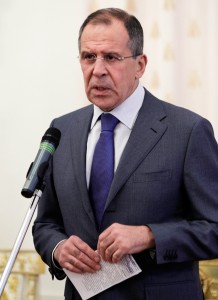
No foreign military interference in Syria! Russian Foreign Minister Sergei Lavrov warns Arab ambassadors gathered in Moscow on Monday, the day after the Arab League voted to impose sanctions on Syria's Government. Photo: AP/Sergey Ponomarev
On Monday, the day after the Arab League voted to impose sanctions on Syria, Lavrov addressed Arab ambassadors in Moscow. He stressed the Kremlin’s policy that internal problems “should be resolved peacefully through national dialogue aimed at promoting civil harmony and without outside interference.”
The meeting seemed to be a warm up for an expected veto by Russia if the Arab League asks the United Nations Security Council to approve sanctions against Syria.
Russia has a lot at stake in Syria. And, despite the talk of peace, most of these stakes are military. For over half a century, Moscow has been the main arms supplier to Syria.
The Kremlin’s stake in Syria stretches all the way back to the Suez Crisis of 1956.
That year, Moscow signed a military aid pact with Damascus.
Relations further tightened after the bloodless coup of 1970 that started the dynasty of the Assads, leaders of the nation’s Alawite minority. A few months after the coup, Moscow signed an agreement for the installation of a naval supply and maintenance base at Tartus, a port in the traditional heartland of the Alawites.
During the Soviet era, Tartus was a key base for Soviet Navy’s Mediterranean Fleet. When the Soviet Union collapsed 20 years ago, this fleet was disbanded and Russian naval power largely receded from the Mediterranean.

These Syrian women living in Jordan don’t seem to want Russian military support for Syria's President Bashar Al-Assad. At a demonstration in front of Syria’s embassy in Amman on November 17, they shout slogans against the Assad government, which the United Nations blames for deaths of 3,000 protesters this year. Photo: Reuters/Majed Jaber
At Tartus, floating docks fell into disrepair and Russian Navy visits became infrequent. Then in 2008, when Russia was flush with oil money, Moscow started to renovate the base. The stated goal was to once again make it Russia’s window on the Mediterranean.
According to the newspaper Izvestiya, 600 Russian technicians now work in Tartus, upgrading facilities, dredging the harbor, and preparing for Russian Navy port calls. Next week, the aircraft carrier Admiral Kuznetsov is to start steaming from the Arctic toward Tartus. The Kuznetsov, which carries at least 10 late model Sukhoi and Mig fighter jets, is to be joined by two other Russian Navy vessels.
Russia’s show of naval force comes one week after an American naval task force, led by the USS George H.W. Bush, the Navy’s newest aircraft carrier, arrived off Syria’s coast.
If gunboat diplomacy is the cards, Russia has an advantage on land. Hundreds of active duty Syrian officers have trained at Russian military academies. Russia-trained Alawite officers could attempt a palace coup, according to one scenario explored by Nour Malas in Tuesday’s Wall Street Journal.

These pro-government protesters in Damascus don’t show signs of planning to retreat to an Alawite coastal statelet. They carry a huge portrait of Syrian president Bashar Assad during a protest against the Arab League on Friday. Two days later, the bloc voted to impose economic sanctions against Damascus for its eight-month long crackdown on dissent. Photo: AP/Muzaffar Salman
Malas quotes an Alawite officer saying from exile in Jordan: “Once they get the green light from Russia, the (Alawite officers) may well go ahead.”
But it is unlikely that Syria’s Sunni majority would accept a revolving door of Alawite minority rule.
In another scenario, Syria would disintegrate into a loose ethnic federation. In this case, the Alawites would retreat to their historical coastal stronghold, an area that was a mini-state during the French Mandate period of 1920-1946. Under this scenario, Sunnis would control Damascus and Aleppo, the nation’s two largest cities. On the Alawite-controlled coast, Russian basing rights would endure intact.
But, it is unlikely that Sunni rulers in Damascus would settle for running a landlocked, rump state.
For now, Moscow is talking peace — but is starting to brandish its big stick.
“A scenario involving military intervention in Syrian affairs is absolutely unacceptable for us,” Foreign Ministry Spokesman Alexander Lukashevich said on Friday, on the eve of the Arab League’s vote to impose sanctions.
Then, on Sunday, within hours of the Arab League vote, a Russian Navy General Staff officer briefed Izvestiya about the deployment of the aircraft carrier to Syrian waters.
As the Kremlin moves its military pieces on the strategic chessboard, at stake in Syria is one of Russia’s two remaining major Arab allies on the Mediterranean. If Syria goes, only Algeria remains from the glory years of Soviet diplomacy in the Arab world.


13 responses to “Syria: Russia Clings to Legacy of Soviet Ties in Arab World”
GOTTA LOVE THE GAME OF CHESS, RUSSIAN PLAYERS HAVE ALWAYS BEEN GOOD AND AT LEAST IN THE HUNT MOST OF THE TIME. ONE WONDERS WHY THEY WOULD PUT THEMSELVES IN THE CORNER OF BASICALLY A BIG BATHTUB. NOT MUCH ECONOMICALLY TO GAIN HERE AND WHY ARE ARABS SO TOUCHY WITH WESTERN BASES BUT DON’T SEEM TO MIND JUST AS COLONIALIST A POWER AS RUSSIA . JIHADI HYPOCRACY OR WHAT.
Sorry, Russia, but you are going to loose Syria pretty soon, and Algeria can hardly be counted on as a Russian ally nowadays. Just as mysterious explosions are happening in Iran, just you wait to see what will happen in Syria. Syria has many more opposition forces just waiting to wipe out the government military, and Russia will just be left watching Turkey leading the NATO allied forces to liberate the Syrian people. Russian can’t really afford to loose Syria, but they can’t afford to keep Syria, because, well, Russia can’t afford hardly anything these days. The best thing that Russia can do is focus on industrializing their country, building good roads, building cars, you know, the regular stuff. There will soon be no more money to be had in selling weapons.
Marisa,
The Syrian people do not want to be liberated…they are liberated….We need to liberate the 10.6 million children that die every year from starvation..not forward the U.S. national interest at the cost of the Syrian…Greed rules the U.S….the majority want the president to stay….why don’t we focus on Israel and their killings of Palestinians….Lets invade Israel for breaking international rules…OoOoh nooo we can’t do that…b/c only us and our allies can commit crimes around the world and justify them as a fight for democracy….We need to focus on national debt not our national oil interests…Russia for Life =D
That is what Yelsin wanted to do . But when Germany attack Yugoslavia again after being defeated twice before in the last century Russia was forced to rearm .. When NATO followed the NAZI attack only fifty yrs latter promising the same minorities ultimate domination of the Orthadox slav serb majority . The same ethnic Orthadox Christian Slavs that almost one million of their parents and childran had been murdered in NAZI death camps in Croatia . This was to much for the Russians to swallow .. Former nazi’s were intalled as the leaders of both Croatia and Bosnia .. U.S General Wesly Clark the commander of all NATO forces issued order to shoot the Russian soldiers helping NATO . These deeds brought Aleksander Solzhenitsyn home to his beloved Russia . Solhenitsyn and the Orthadox Christian Church abandon Yelsin and his new liberal democratic party , They started the United Party of Russia and selected Putin …Putin promised to strengthen Russia and return her to her historic judo christian roots . Solzhenitsyn has now passed on , but his final accomplishment of strenthening Russia , economicaly , religiously and militarly was somthing to behold . I dare say Russia under Putin built more Christian Chuches than all the rest of Europe . Russia you say has only one aircraft carrier , you should see the one they just built for Chinia . We gave Russia no choice , look what happend to Yugoslavia . we forced Russia to become friends with Iran . We forced Russia to consentrait on self defense , look what Georgia tried to do to South Ossettia .. Russia was ready in 2008 to confront all of NATO
I like very much the balanced assessment of Russia’s stance and prospects in the region given in the article.
I would rather not imply Russia in the context of the reckless gamble as the Russians are held hostage by Mr. Putin and his advisers in their international politics.
Putin & Asad are autocrats of a feather, they flock together.
Putin and the dark forces he is archetype to represent are desperate to cling to the despotic methods of medieval kingdoms’ rulers. It looks as dinosaurs (these two autocrats) have emerged in modern and sophisticated age of electronics and drones.
In internal politics Putin has already failed in keeping his electoral promises, he has failed in rebuilding prosperous and modern realm of law and order in Russia. Maybe he wasn’t as bad when he was a Russia’s default manager in 2000, but his term has long expired. His future rule in Russia will be a disaster. Everybody witnesses his and his clout gross incompetence nowadays. He personally looks a kind of a walking joke of a retired Hollywood star with his Botox face riding bygone days Lada car, flying a jet, congratulating the Russian emigrated scientist in London with his Nobel prize, diving to the bottom of a sea.
The only thing he hasn’t yet tried is to convince electorate in the presence of his intelligence and mind as he and his cronies have never participated in any open impromptu debate.
So I bet this use by Putin & Co of gunboat diplomacy will be just a puff and a bluff and it will be one more nail in the coffin of his autocratic Presidency.
Assad is resound to an inter-generational conflict, hence the killing of children, Russia tried that in Afghanistan. So he is trying to kill the next generation of fighters. Insurgencies generally take around 20 years to come to end.
If I was going to choose a place to have an insurgency in the Middle East it would be Syria, the Russia strategy reversed back on them, during the USSR the resistance block had Israel surrounded, while people talk of Hizbullah rockets, the resistance block of those years of mechanized armies was much superior. Slowly the resistance block was broken up Egypt and Jordan peace treaties, Saddam was removed, so it is Assad that is surrounded.
They today still have around 4 members Syria, Iran, Hizbullah and Hamas. The Middle East is far different today, as countries are untied against the Iranian nuclear bomb, that is the man fear. So Syria is surround on all flanks and the resistance block is far weaker and with Syria internal problems it just got weaker again.
So you have the FSA, inside Jordan, Lebanon, Turkey, Sunnis in Iraq and Kurds. Assad has settled on the ambiguity of the FSA being hosted in border states.
This is why sea access is very important a unilateral blockade would hurt Syria, after AL sanctions that could go into affect.
See the uptick in violence in the Caucasus, was due to the Georgian war, diverted units from Chechnya even for that sort period of time, created a few years of increase activity. Why Georgia is good is because the supply of logistics has to go through those areas, one of the reason Russia need LHD’s. Independent states would provide a buffer zone for Georgia, from Russian aggression. If freedom is fine in the Middle East from dictators why not the Caucasus, if we do not fear it in the Middle East why anywhere else. Just throwing it out there.
Anyway that carrier is prone to breakdown so it becomes a sitting target and or slows down the whole strike group, allow it to be wolf packed, it is fine to keep your skills up in carrier operations but I would never send it too war. I think everyone learned something from Pearl.
Usually Assad would not tolerate any of this an Hizbullah would have been used against Israel, but Hizbullah is Iran’s strategic confidence/deterrent (to build the bomb) Assad needs Iranian support so there strength is turned into a weakness. Imad and Suleiman help further create this dilemma, as did Hariri forcing Syria to decamp.
US troops are out of Iraq so Iran has lost their human shields, then to lose Hizbullah the strategic confidence/deterrent to push ahead an build the bomb. Divide and conquer.
Syria committed many crimes and violations against human rights, it should go down. But let’s be honest about this, what the difference? one criminal would go another would come sooner or later in these countries.
And all those who support this regime now are being part of its criminal acts as well, Bashar deserves no less punishment than kaddafi.
Evreything is relative what if Gaddaffi deserved less punishment that what is replacing him . What if Shaw deserved less punishment than what replaced him . What If Murbank deserved less punishment than what replaces him . What if Milosevic deserved less punishment than the organ harvestors that replaced him . What if Basher deserves less punishment than who replaces him . Maybe Batesta deserved less punishment than Casro who replaced him . I would than say the United States has been fighting on the wroing side . So why not just stay out of Foreign entanglements
Генадий у тебя мозг поплыл ?
russia is tarzan, nato and usa, jane. if you don’t agree, go ask the polish leaders families. if it ever starts, it’s all battlefield nukes and nothing else counts, russia has been ahead in the missile race always. grow up and quit watching john wayne movies!!
Why do my “fellow Americans”, like many of these posters, insist on more pointless wars? America is bankrupt, stop beating your chests, in the immortal words of ‘The Eagles’, “Get Over It.” We can’t afford being an empire anymore. More chest beating or granny starving is what it’s all come down to.
I don’t know Putin yet accept president Bush seen his eyes and thought He had a good sole . I think I know Aleksander Solzhinitsyn and would trust him with my life .. Solzhenitsyn and the Russian Orthadox church founded the United party of Russia not Putin . maybe Putin has out lived his usefulness . I can certianly understand the young Russians thinking they should have more . especialy when they compare what they see all over the rest of europe . early retirements , month long vacations . a life of efluence and luxurey compared to the poor infustructure , poor health care and meagor living conditions imposed on them from Putin and Medvedev .
The no 1 job of any govornment is defense of the country . Russia with all the natual resources they have would be a better candidate for foreign developement than Yugoslavia ever was . Putin at least saved his country for developement by the Russian people . Seems to me the number of T.V. sets and the classy sports cars , or large air condioned apartments are not really the best way to judge a countries govornment . I think the Russian commanders response to president Demitry’s question ” NOW WHAT DO WE DO ? DONT WORRY IF THOSE WAR SHIPS CUASE TROUBLE HERE I CAN MAKE THEM ALL DISSAPEAR IN A FEW MINITUTES ” Putin strengthend Russia faster than Hitler strengthed Germany in the 30s The world knew the bear was back . I don’t believe Russia could actually defeat NATO but they sure could make NATO wish they never tried Russia . Putin brought a bankrupt Russia back on line in only 8 yrs . I’am inclined to believe Solzhenitsyn made a good choice in selecting Putin .
i also think putin made a good choice selecting medevdev